A · Black steel divided tower
30W×20D×84H inches · about 21 ft³ usable shelf envelope
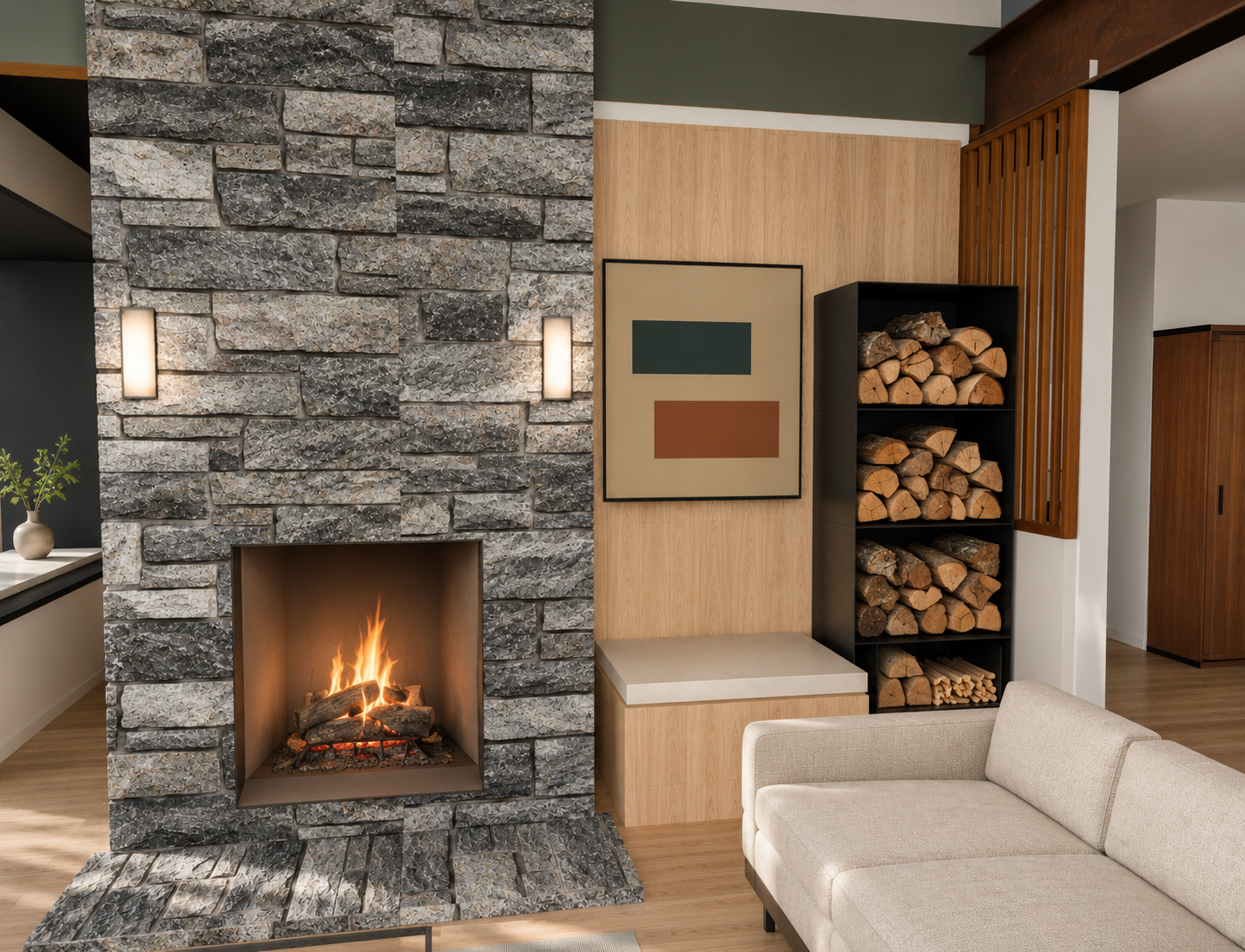
Four shelf bays, each with a back and side cheeks, short stacks, removable bark trays and a discreet anti-tip attachment. Matte black ties to the window frames and kitchen details.
Simple to fabricate and clean; compartments let you use one pile without destabilizing the others. The remaining bench is about 42 in wide. The artwork becomes narrower/portrait-shaped.
The most straightforward option for the requested long weekend. Its usable envelope is roughly 7 times the old bay’s maximum envelope.
Download full-size photograph · See the source 3D viewB · Patina steel staggered tower
36W×20D×84H inches · about 24 ft³ usable shelf envelope
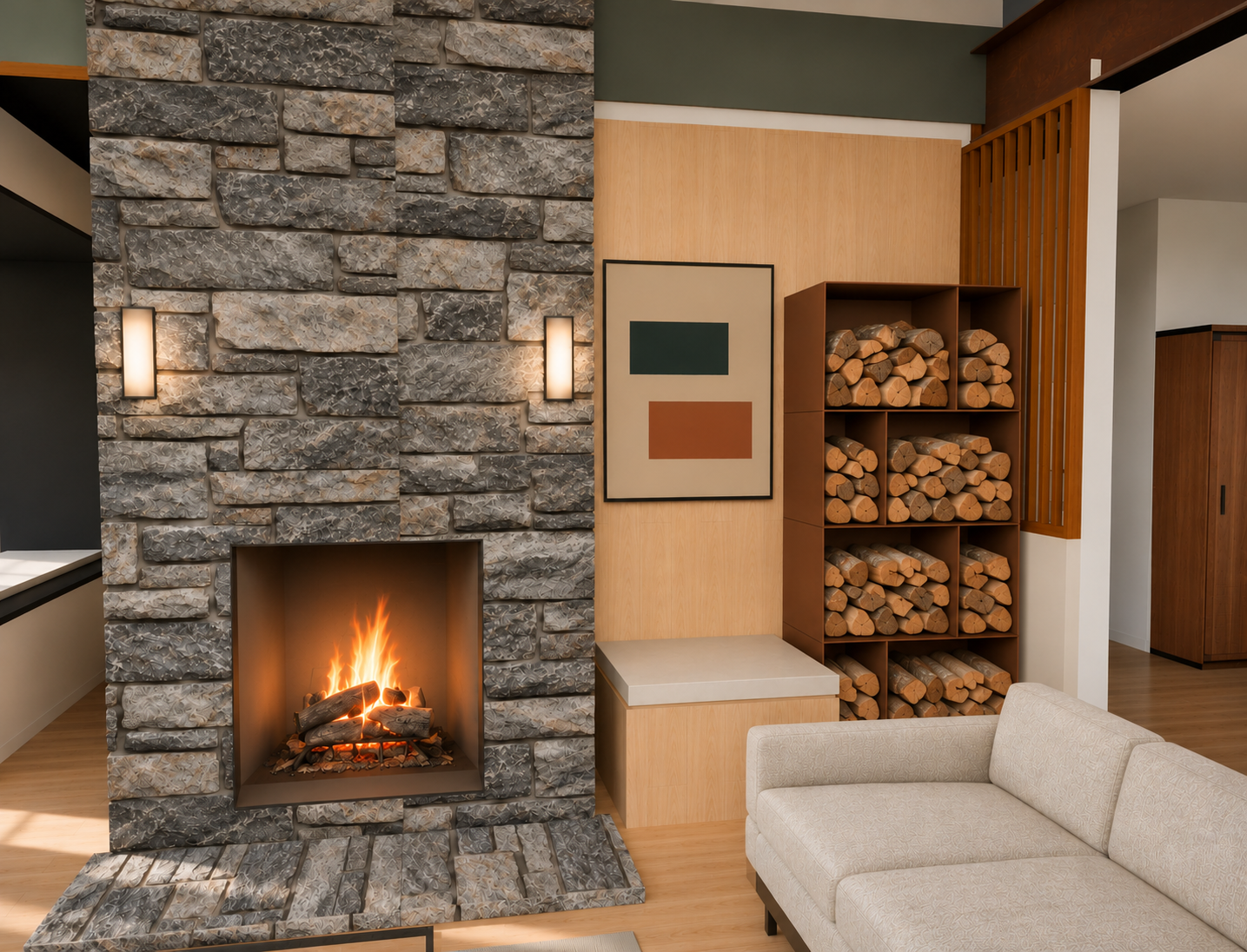
Four broad tiers with alternating vertical dividers. A sealed rust/patina steel appearance connects with the exposed kitchen beam without making every metal surface identical.
More wood and interesting proportions, but visually busier. It leaves about 36 in of bench and a narrower artwork. Specify a stable sealed finish that does not shed rust or stain floors; do not use untreated weathering steel indoors.
Largest reserve of the three, about 8 times the old bay envelope. Dividers need a fabricator-designed load path and shelf gauge.
Download full-size photograph · See the source 3D viewC · Low steel reserve cabinet
40W×26D×36H inches · about 12.8 ft³ usable bin envelope
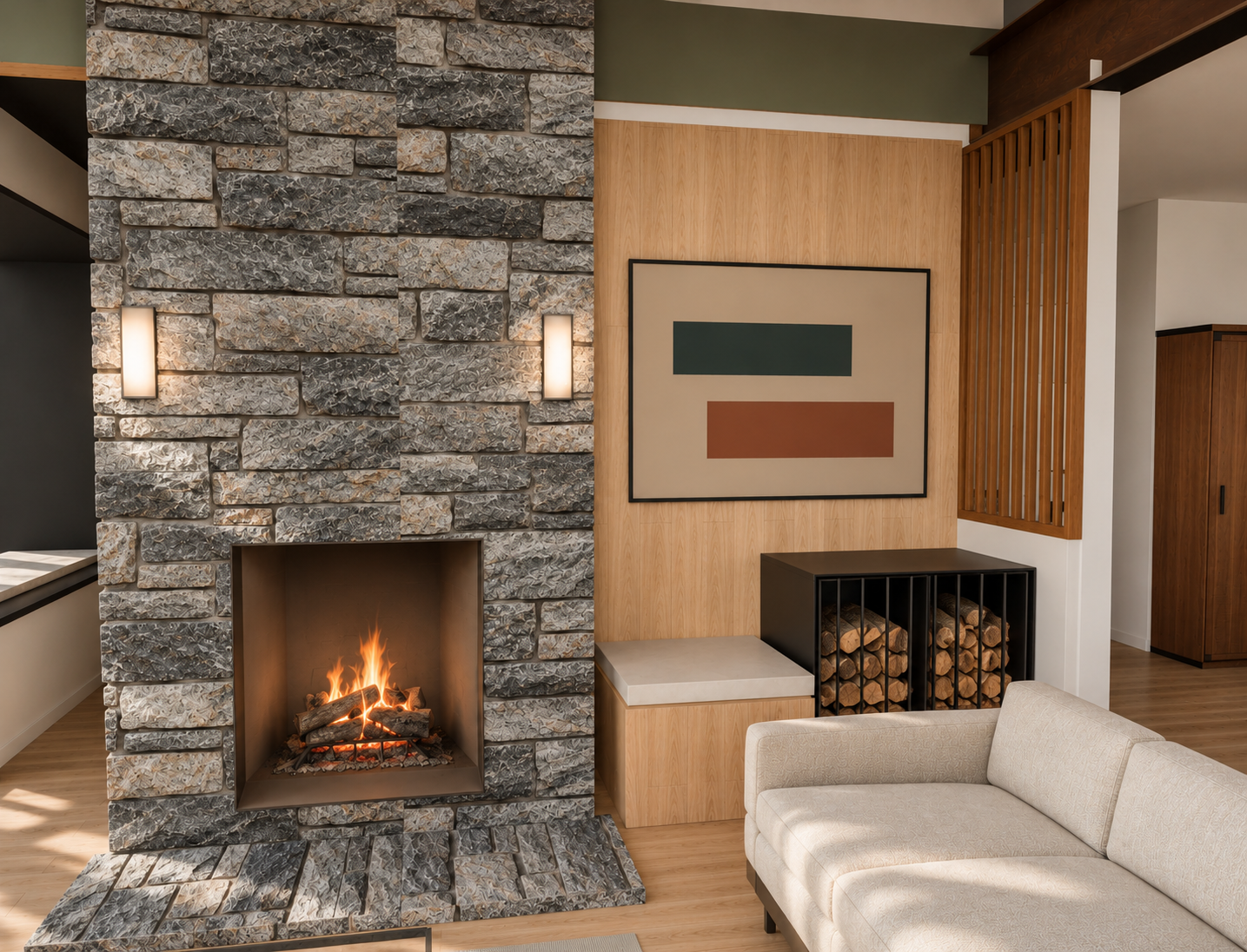
A low black steel cabinet with two removable reserve bins and a slatted front. It stores more wood out of sight while retaining the broad artwork; the cabinet top is a ledge, not a fireplace mantel.
Easier reach and less visual clutter; roughly 4 times the old bay envelope. It is deeper and gives up more bench length, leaving about 32 in of seat. Loaded bins must be shallow enough to handle safely or supported on rated slides.
Choose this if preserving the large artwork matters more than a vertical log display. A small removable carry basket can bridge the last few steps to the fire; no decorative basket capacity is counted.
Download full-size photograph · See the source 3D viewHow much is enough?
The old bay is approximately 22×18×13½in: only 3.1 ft³ before the liner and imperfect stacking. The new figures are usable geometric envelopes, not guaranteed solid-wood volume or a promised number of burning hours. Actual log size, gaps, species, moisture and time spent enjoying the fire determine consumption.
| Storage | Approximate usable envelope | How it behaves |
|---|---|---|
| Previous bay | At most 3.1 ft³ gross | Small top-up supply |
| A · Black tower | 21 ft³ | Four independent short stacks |
| B · Patina tower | 24 ft³ | Tiered reserve with divided compartments |
| C · Low cabinet | 12.8 ft³ | Two removable reserve bins |
For your long-weekend goal, I would start with A and fill it before arrival or at the start of the stay. Track the first few weekends’ actual use before making a guaranteed refill interval. If you want an additional buffer later, use a separate dry indoor reserve away from the fireplace and living-route clutter; do not extend the rack into the hearth zone.
Placement and safe use
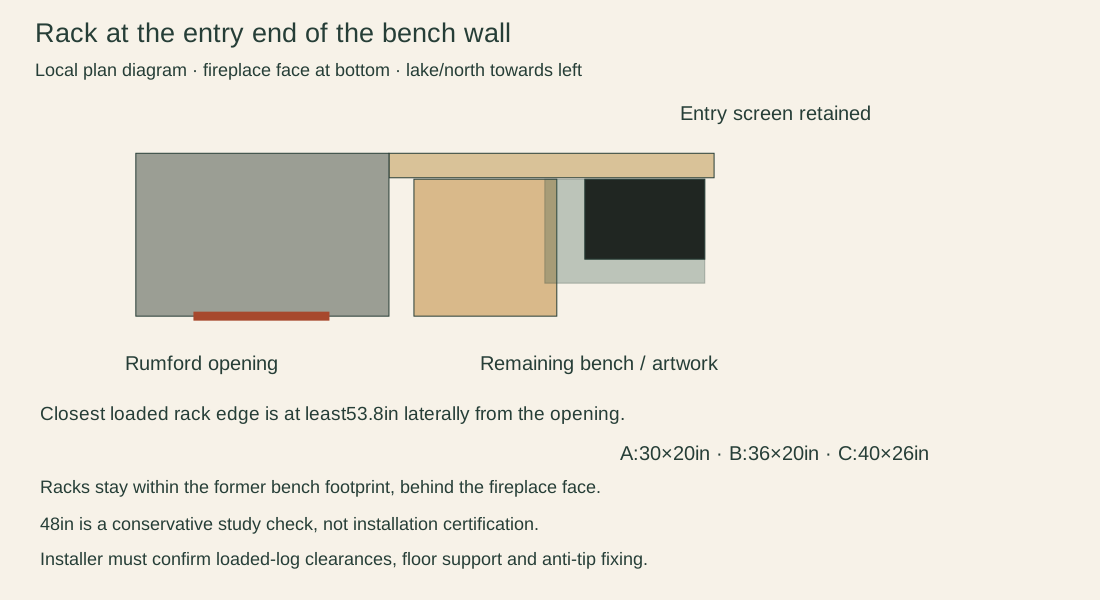
The racks sit at the entry end of the former bench footprint, with their stored logs behind the fireplace face. The closest option edge is about 53.8 in laterally from the nearest opening edge. This conservative 48 in study check does not replace installation verification.
Steel does not make the stored firewood non-combustible. The Rumford 1000B owner’s manual, page 4 keeps firewood and other combustibles at least 4 ft from the fireplace front. The installation manual also controls side clearances, facing and the hearth extension. A steel shelf or box is not an approved heat shield. The installer must approve the loaded rack position and keep the door, screen, hearth and service access clear.
Use dry, seasoned split wood. Include side cheeks/back stops, low front retainers, removable bark trays, rounded metal corners, a cleanable floor gap and anti-tip fixing into structural backing. Have the fabricator size shelves/anchors for the full wettest-expected wood load and verify floor support. A tall loaded rack is furniture with a significant concentrated load; the illustrations are not fabrication drawings.
Other attractive directions worth considering
Buy a designed steel log holder
Dixneuf Vertigo XL is a useful capacity benchmark: the manufacturer lists up to 70 logs. Its sculptural black frame is attractive, but it does not give the four independent shelf piles proposed here. Canadian stock, shipping and a delivered price are not verified.
Coordinate the rack and fireplace tools
Focus Kasifocus is a matte-black steel log holder supplied with tongs, shovel and poker. It supports the idea of one restrained steel composition rather than multiple unrelated accessories. It is a style reference, not the product shown in A or B; custom dimensions, fabrication and supply need quotes.
A custom local fabrication is the strongest fit for this wall: it can follow the masonry proportions, use shelves at useful heights and fit the actual circulation. I have not invented a Canadian installed price or lead time; those need a drawing-based fabricator quote.
Model, capacity assumptions and retained attempts
The source is the R28-derived current-preference timber study. Only the Great Room bench/artwork/storage proposal changes; architecture, Rumford 1000B 34×37 in aperture, nook bookcases, Oriel seat and entry return remain. Both tall options explicitly resize the artwork above the shortened bench; C retains the original artwork size.
The native render guides were checked against the actual loaded source vertices and camera. Photographs are generated appearance interpretations, not measured matched-image certification or approved construction. The current house has separate window-order discrepancies; these close fireplace-facing cameras do not certify the glazing or silently redesign the repaired roof.
A assumes four 28×18×18 in clear shelf bays; B allows about 24 ft³ after dividers; C about 12.8 ft³ of clear reserve-bin volume. These are planning envelopes, not rated loads or guaranteed wood counts.
Source geometry and proposal evidence · Prompts and generation history